This topic is one that I am quite familiar with. In Alison Bechdel’s graphic memoir “Fun Home”, both Alison and Bruce struggle with understanding their sexuality and deciding how much of themselves they are willing to share with others. However, they experience this differently. Bruce spends much of his life hiding his sexuality, while Alison is more open about discovering and accepting hers. Their experiences make us pay attention to how differently suppression versus expression can affect not only someone’s life but also the lives of the people around them. I came out at 13 while growing in a conservative African household and it was not an easy experience because at the time our society was very closed minded. People were very cruel towards gay men but idealized gay women as if their sexuality existed for other people’s entertainment or approval, but similar to Alison I was eager to explore that part of myself, and eventually this affected my relationship with my mom. I remember feeling like I had to act a certain way to receive not only her approval, but everyone else’s. I sometimes felt pressured to present myself in a more masculine way to prove that I was serious about who I loved. I was still figuring out my own identity, but the expectations placed upon me were exhausting.
One of the binaries from Eve Kosofsky Sedgwick’s Epistemology of the Closet that I chose to explore is secrecy/disclosure. Bruce is an example of how secrecy can influence almost every part of someone’s life. He is a closeted gay man who maintains the appearance of a traditional husband, father, and member of the community. From the outside, he seems to have the typical family life that society expects of him, but behind closed doors, he has relationships with men and keeps this part of his life “hidden”, constantly battling these two sides of himself. Alison’s experience on the other hand is a disclosure. When she begins exploring her sexuality, she is comfortable in who she is, and she feels it is important for her parents to know this assertion. As if the truth will set her free. When Alison comes out as a lesbian to her parents, it also brings attention to her father’s own sexuality and the things her mother had to endure to keep this a secret so instead of feeling a sense of relief in her disclosure, she says she had been upstaged, demoted from protagonist in her own drama to comic relief in her parents tragedy (Bechdel, 58).
On page 11 of Epistemology of the Closet, Sedgwick identifies secrecy/disclosure as cultural binaries that are connected to sexuality. She also explains that silence can be meaningful, meaning that not talking about something does not necessarily mean that people do not know about it. There is still a difference between knowing something and openly acknowledging it. Sometimes people choose not to discuss what they already know because addressing it would force them to confront something uncomfortable. Bruce’s silence affects his family because the things he keeps in the dark create emotional distance and prevent his family from fully understanding what he is experiencing. His secrecy does not only affect him, it also affects his wife who is left dealing with the consequences of a marriage based on appearances. Alison’s decision to speak up, on the other hand, brings hidden family issues to light and although she is being honest about who she is, her disclosure forces her family to speak on what’s been kept unspoken for years.
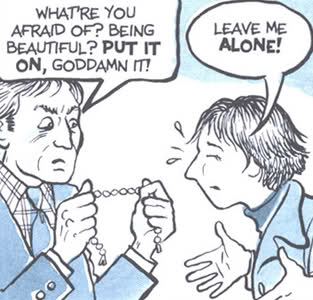
Alison’s description of herself and Bruce as “inversions of one another” shows that both hiding who you are and being open about it are deeply tied to social expectations (Bechdel, 98). Bruce spent his life keeping secrets, hiding his sexuality while trying to control everything around him to fit in. Alison took the opposite path by choosing disclosure, using her honesty to build an authentic life. Still, she points out that their choices were constantly influencing each other. “While I was trying to compensate for something unmanly in him… he was attempting to express something feminine through me” (Bechdel, 98). This shows that keeping secrets and coming out are not totally separate ideas. They are two different ways of reacting to the same pressure to conform. Bruce’s secrecy forced Alison to carry part of his burden, just like society often pressures us to present ourselves in specific ways just to be taken seriously. In the end, both Alison and Bruce reveal that whether you choose silence or openness, the struggle to define yourself in a world full of expectations shapes who you are and how you connect with the people closest to you.


Leave a Reply